

or:— The most important letter in the word ‘Israel’ is the missing ‘n’
Rabbi Gabriel Kanter-Webber
Last week, a number of British rabbis, including myself, my colleague Lev Taylor and my teachers Elli Tikvah Sarah and Colin Eimer – along with over 2,000 other rabbis and Jewish academics and other public figures – signed an open letter about the situation in Israel.
As far as I know, this is the first time that mainstream British Jewish figures have publicly used ‘the A-word’ in relation to Israel. Our letter contained the following sentence: “Palestinians live under a regime of apartheid.”[1]
I know that this is controversial (so controversial that one of our rabbinical colleagues kindly labelled the signatories “pathetic” and “disgusting”). So I’d like to explain why I decided to sign.
My chain of reasoning starts with a man called Israel Koenig. Israel Koenig lived, appropriately enough, in the Galilee, and at the height of his career he was the senior civil servant in charge of everything that went on in the north of Israel. In 1973 he wrote a top-secret report for the Prime Minister. And it was leaked to the press.[2]
His report addressed what is popularly termed the “demographic race between Jews and Arabs”.[3] In less euphemistic terms, Koenig was deeply worried that thanks to Israel’s conquest of the Gaza Strip, the Golan and the West Bank, Israel’s Jews were in danger of being outnumbered by Palestinians.[4] Their population increase, he wrote, was giving them “hope”.[5] And he couldn’t have that.
Fears of demographic change are nothing new. At the very start of the Book of Exodus, Pharoah warned: “Look, the Israelite people are too numerous for us.”[6]
And, just like Pharaoh, Koenig had an evil plan for how to keep the people he feared in their place. Determined to “dilut[e…] Arab population concentrations”,[7] he suggested banning companies from having a workforce that was more than 20% Palestinian;[8] creating artificial red tape to “encumber” Palestinian salespeople so as to “avoid dependence of the Jewish population on [them]”;[9] cutting child benefit payments to Palestinian families “so that the grant is paid to Jews only”;[10] encouraging all agencies to “giv[e] preferential treatment to Jewish groups … rather than Arabs”; introducing policies designed to encourage Palestinian students to drop out of university (because higher education leaves them too much “time for dabbling in nationalism”);[11] making it easy for Palestinians to enrol at foreign universities “while making the return … more difficult”;[12] and more generally “encourag[ing] their emigration”.[13]
The Koenig report’s proposals are nothing short of wicked. Had they been implemented, it would surely not be controversial to describe the resultant regime as an apartheid state.
And the fact is, many of the proposals were adopted. Seven years after Koenig proposed it, the Knesset indeed created a system whereby extra child benefit was paid to large families… so long as they were Jewish.[14] Similarly, Palestinian students studying abroad are indeed subject to strict limits on whether or not they can return to their homes and their families; Jewish students have no comparable restrictions.[15]
Even if we put aside overtly discriminatory policies like these, successive Israeli governments have made it a priority to ensure that the population’s racial balance tips in their favour. Golda Meir used to joke that, when she was Prime Minister, she “[woke] up every morning wondering how many Arab babies [were] born during the night”.[16] Promoting reproduction among and between Jews has always been seen as vital. Professor Nira Yuval-Davis has lamented the way in which “Israeli Jewish women have been recruited … as suppliers of children to the nation”.[17]
The fact is that all of this demographic tinkering is based on one very specific understanding of Zionism, in which the adjective ‘Jewish’ in ‘a Jewish state’ is taken to refer to statistics. A state where more than half of the people are Palestinians, runs the argument, cannot be called a Jewish state and, indeed, is not a safe place for the Jews.
But while that has always been the usual understanding of Zionism, it has never been universal. Martin Buber, for example, always said that the quest for a Jewish majority was a bad idea. In 1944, he wrote:[18]
[A]t decisive moments, the power of decision rests with the majority which can determine the fate of the minority. And this is not what we aspire to. Just as we do not want our neighbours to determine our fate, we do not want to be in the position of determining theirs.
He went on to warn that, in any event, the installation of a Jewish majority could only happen if the Zionist pioneers resorted to undemocratic methods: “in order to become the decisive force – the majority – we must [first] be given the decisive power as if we were already the majority”.[19]
I stress again that this was written by Martin Buber. Buber was one of the greatest Jewish thinkers of the 20th century – and someone who can by no means be considered a “pathetic” and “disgusting” traitor to the Jewish people. If he said it, we should listen.
And he wasn’t the first. The 1920s Zionist ideologue Hans Kohn argued that the Jews should seek “not a quantitative majority, but a qualitative way”.[20]
Putting it in my own terms, the most important letter in the name ‘Israel’ is the missing letter ‘n’: the notion of a Jewish state should be defined by its being ethically Jewish, rather than ethnically Jewish.
Of course, there’s nothing wrong with being ethnically Jewish. My shul, after all, is way, way, way over 50% ethnically Jewish, and we do OK. But, on the national level, it isn’t possible to engineer that situation by design.
The State of Israel was established in a place where Palestinians lived, and then it expanded its borders into yet more places where Palestinians lived. Given the vagaries of birth rates, there was obviously a significant chance that Jews would be a numerical minority. And there is no way of remedying that situation – none at all – that doesn’t involve the use of tactics that are unethical, discriminatory or just plain evil.
How can one racial group’s population be artificially increased relative to another? History, both distant and recent, provides us with many chilling examples.
Child murder is one extreme option (as Pharaoh decreed upon the Hebrew slaves);[21] deportation another (a tactic of which Jews have also been historical victims).
The risk of the favoured racial group being outvoted can of course be averted perfectly simply by the withdrawal of electoral rights from the disfavoured group, which no doubt explains Israel’s decision to allow all Israeli Jews resident in East Jerusalem and the West Bank to vote, while refusing to grant the same privilege to their Palestinian neighbours.[22]
The Koenig report provides ample examples of other possible strategies, some of which were, as we have heard, actually implemented. And there are more instances as well. A Jewish Israeli child who is arrested has a legal right to be accompanied by a parent; a West Bank Palestinian child doesn’t.[23] An arrested Jewish Israeli must be given access to a lawyer within 48 hours; an arrested West Bank Palestinian can be held for 96 hours without a lawyer.[24] Since 1967, the law has allowed Israeli police to disperse political gatherings of more than 10 people, but in all that time they have only ever exercised this power against Palestinians.[25] When distributing publicly-owned land for building projects, the government gives 99.76% of it to Jewish projects, leaving only 0.24% for Palestinian ones.[26] Palestinians are banned from entering parts of the West Bank with an Israeli presence unless they have “cause” (which in practice means those who are employed as cleaners and gardeners by settlers).[27]
I could go on, but it is frankly too dispiriting to do so. There is ample material to sustain the open letter’s conclusion that Palestinians live under a regime of apartheid.
Moreover, it isn’t even as if it’s just the Palestinians. Mizrachim – those Jews whose heritage lies in the Middle East and the Arab world – are also subject to entirely intentional discrimination, disadvantage and cultural erasure. Professor Ella Shohat, a Jew of Iraqi extraction, has said:[27a]
Official Zionism’s selective reading of Middle Eastern history […subordinates] Arab Jews to a ‘universal’ Jewish experience. Zionist history texts undermine the hyphenated … culture of actually existing Jews, rendering the non-Jewish side of the hyphen nonpertinent. This unidimensional categorisation, with all Jews being defined as closer to each other than to the cultures of which they have been a part, is tantamount to dismembering a community’s identity. And indeed, in the case of Middle Eastern Jews, the Euro-Israeli separation of the ‘Jewish’ and ‘Middle Eastern’ parts has ideologically facilitated the actual dismantling of the Jewish communities of the Muslim world, while pressuring the Oriental Jews in Israel to realign their identity according to Zionist Euro-Israeli paradigms.
None of this is remotely acceptable in any entity claiming to be Jewish. Whether the percentage of citizens who are Jewish by race is 2% or 92%, a polity which contemplates, even for a single second, behaving in this way, has drifted impossibly far from the ideal of a Jewish state. Without our values, our ethics and our principles, we are nothing.
Professor Yeshayahu Leibowitz used to argue that the most important moment in Jewish history was the seventh day: that is, the seventh day of the Six Day War. The moment when Israel decided not to give back the territories it had conquered, but instead to become an occupying power.[28] He said that the occupation:[29]
[M]eans undermining the human and Jewish essence of the state and destroying its social structures. It severs the state from Jewish people in the wider world, and repudiates Jewish history and traditions. It will destroy the Jewish people and corrupt human life within Israel. In this [new] Greater Israel … we will become a nation of managers, supervisors, officials and police (especially secret police). The state will become a police state. This will inevitably affect the spiritual and moral character of the state and of society. It will poison education and stifle freedom of thought and freedom of speech … This will be a state that does not deserve to exist and which would not be worthwhile to maintain.
I have to agree that, if Israel can only sustain itself by adopting unethical and discriminatory policies, it would be better to abandon the whole Zionist project and return to the Diaspora.
But that’s a big ‘if’. And I’m not as pessimistic as Professor Leibowitz in that regard. I think Israel can revert to being a Jewish state in the way that I have identified: ethically Jewish, without the ruthless focus on ethnicity.
On the doorpost of a Jewish house, there will very often be found a mezuzah. It’s easy to take it for granted (‘OK, the person who lives there is Jewish, but I worked that out already because their name is Goldberg’) but let’s think about it. A mezuzah is not just a piece of decoration; it contains a little fragment of Torah. It binds us together not merely by being a shared custom, but by representing our sacred and value-laden texts.
In this Shabbat’s parashah, we read God’s commandment to the founders of the very first State of Israel, that they should carve the entire Torah onto slabs of stone and leave them at the top of Mount Eival.[30] The Spanish commentator Abarbanel points out that they were, effectively, a giant mezuzah.[31]
And that is a truly wonderful image. The land of Israel has a mezuzah. The country as a whole has one. And with that mezuzah comes responsibility. It is a public declaration that the ‘house’ within – the state – is bound together not only by culture, food and family, but also by Torah.
Torah, that recites the mournful history of the oppression which our people has faced at the hand of powerful rulers. Torah, that implores us to treat others as we would wish to be treated. No group of people bound together by Torah can shove these timeless principles aside for the sake of political expediency, not even out of fear.
The land of Israel has a mezuzah. It has held itself up to be an ethically Jewish state. If that means it cannot at the same time be an ethnically Jewish state, so be it. (And after all, somewhere less than 50% Jewish can still be a safe place with a strong Jewish character. Look at Temple Fortune.)
Israel’s leaders have forgotten that their country needs a mezuzah. For decades, they have allowed themselves to be sidetracked from the pursuit of righteousness and Torah and from the imperative of becoming an ethical light unto the nations. Instead, they have spent their energies foregrounding the interests of one particular racial group at the expense of the other groups unfortunate enough to find themselves under Israeli control.
In such circumstances, I consider myself to have a duty to speak out.
That is why I signed the letter.
This essay is written in an entirely personal capacity. If you agree with it, you’re very wise. If you disagree with it, feel free to post a polite, reasoned, non-abusive, non-Islamophobic, non-antisemitic comment below. If you’re too furious to engage rationally, turn your computer off and go for a walk. If you think I’m unfit to be, or to work as, a rabbi, that’s unfortunately not something within your control so you’ll have to try to find some way of coping.
I know it’s bad form to quote one’s own reviews, but I’m so excited that this essay received the following celebrity endorsement:
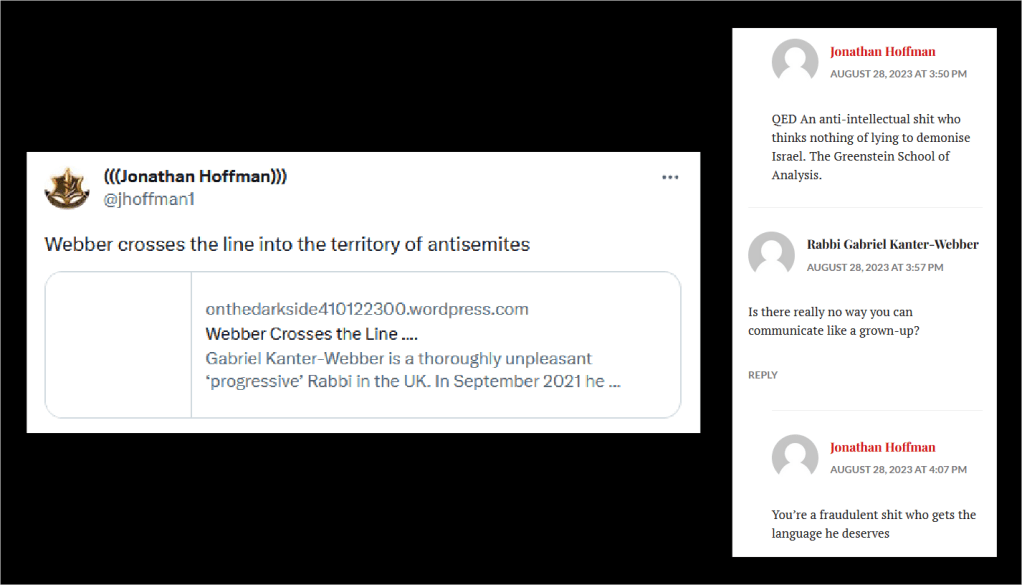
Notes
[1] Academics Speak Out, “The elephant in the room” (2023): <https://sites.google.com/view/israel-elephant-in-the-room/home>
[2] Israel Koenig, “The Koenig report”, Journal of Palestine Studies 6 (1977): 195-205. The translator is not identified. I have not had sight of the original Hebrew.
[3] Nira Yuval-Davis, “National reproduction and ‘the demographic race’ in Israel”, in Yuval-Davis and Floya Anthias (eds), Woman-Nation-State (New York: Palgrave Macmillan, 1989), 92-109: 92.
[4] In this sermon, I will use the term ‘Palestinians’ as it is Israel’s desire to prevent and undermine Palestinian nationalism which is at issue. However, when quoting a source which uses the term ‘Arabs’, I will quote it faithfully.
[5] Koenig, ibid: 192.
[6] Exodus 1:9
[7] Koenig, ibid: 193.
[8] Ibid: 195.
[9] Ibid.
[10] Ibid.
[11] Ibid: 196.
[12] Ibid.
[13] Ibid.
[14] Jacqueline Portuguese, Fertility Policy in Israel: the politics of religion, gender and nation (Westport, Connecticut: Praeger, 1998): 105.
[15] Ibid: 180-181.
[16] Yuval-Davis, ibid.
[17] Ibid: 100.
[18] Martin Buber, A Land of Two Peoples: Martin Buber on Jews and Arabs, trans Paul Mendes-Flohr (Chicago: University of Chicago Press, 1983; repr 2005): 166
[19] Ibid: 167.
[20] Hans Kohn, “Ba-Avodat ha-ye’ud”, Ha-Po’el ha-Tza’ir [Hebrew], 25 November 1927, 14-16: 16.
[21] Exodus 1:15-16
[22] Michael Sfard, “The Israeli occupation of the West Bank and the crime of apartheid: legal opinion”, Yesh Din (June 2020), <https://s3-eu-west-1.amazonaws.com/files.yesh-din.org/Apartheid+2020/Apartheid+ENG.pdf>: 25, 39.
[23] Military Court Watch, “Discrimination” (undated): <https://militarycourtwatch.org/page.php?id=RyO5OsFMaZa27579A0cctVm0lxd>
[24] Ibid.
[25] Sfard, ibid: 50.
[26] Ibid: 29, 43-44.
[27] Ibid: 45.
[27a] Ella Shohat, “The invention of the Mizrahim”, Journal of Palestine Studies 29 (1999), 5-20: 6.
[28] Yeshayahu Leibowitz and John P Egan, “Liberating Israel from the occupied territories”, Journal of Palestine Studies 15 (1986), 102-108: 105.
[29] Yeshayahu Leibowitz, Emunah, Historiyah v’Arachim [Hebrew] (Jerusalem: Academon, 1982): 225. A similar, though not identical, essay was translated into English by Yoram Navon in Eliezer Goldman (ed), Judaism, Human Values and the Jewish State (Cambridge, Massachusetts: Harvard University Press, 1992): 223-228.
[30] Deuteronomy 27:1-4
[31] Abarbanel to Deuteronomy 27
 Rabbi Gabriel Kanter-Webber
You’re a liar and not fit to be a spiritual leader
As I said in the post: “If you think I’m unfit to be, or to work as, a rabbi, that’s unfortunately not something within your control so you’ll have to try to find some way of coping.”
Your management has previously proved useless at responding to complaints. Hopefully things will change with the merger.
I somewhat doubt that the new organisation’s articles of governance will give you the power to decide who may and may not be employed as a rabbi, but I guess we’ll have to wait and see what they come up with.
Thank you for stepping in and being bold enough to use your voice and platform to share *our* voice. You are not alone! I have also been called an Antisemite for expressing my strong opinions about our Palestinian brothers and sisters living under a shameful Apartheid Regime. Chapeau and Shabbat Shalom